

 Many people neglect to learn any of the local language before jetting off to a new destination. It’s usually when you’re stuck without the universal language, English, that you regret not knowing even the most basic of words. Rather than try to learn an entire language or dialect you can focus your efforts on 4 word combinations that will help you be understood especially when you need it most.
The list is short enough to where you can pick them up on the plane ride and jot them down on a piece of paper in your pocket for quick reference.
1. Hello and Goodbye
I can see you saying ‘duh’ now but I can’t tell you how many people hop off a plane in a new country without memorizing this simple greeting along with its counterpart. Sure you know ‘hola’ but what about “merhaba”, “hej”, or “nǐ hǎo”? It’s not always as simple as you think or a direct translation. In Turkish goodbye (when you’re the one leaving) is “allahaısmarladık” and when you’re sending some one off “güle güle”.

2. Please (Used Correctly) and Thank You
In many languages adding please at the end of a request just doesn’t fit or sound right as it does in English (“Can I have some more coffee please“?) or is not always appropriate. Do a little Google searching and find out the context of when to use please. It helps to know some words in a language but you’ll understand more about the culture by using the words correctly in context.

3. Left and Right
Ever hop into a cab with a shady taxi driver who you know isn’t taking the most direct route? What about asking for directions when you get lost? It’s not so fun to play a game of charades when you’re lost in Tokyo trying to find your way to the next monument or back to your hotel. Use “left”, “right”, and some other quiet ways in the cab and any driver will think twice about taking you for more of a ride than you were expecting.

4. Here and There
Sherry Ott also brought up some other great direction phrases, in addition to these basics. I always like to watch people try and explain “stay here” and “I’ll be right back” only to walk away and have a hotel clerk run after them. Pointing doesn’t always work either, it’s rude in many cultures and even though you’ll probably be forgiven as a tourist you’ll miss out on these subtle cultural cues.
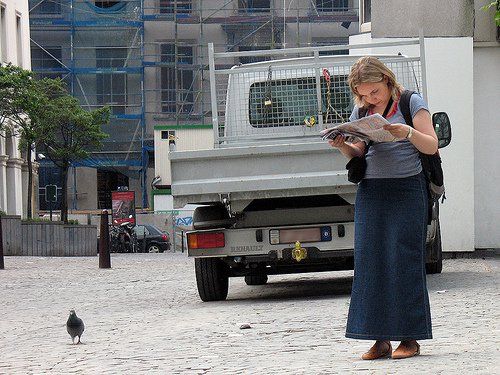
Not Good With Languages?
There are plenty of free ways to learn a bit more of a language while you’re waiting around the airport or a few days before your trip that don’t require a physical book of translations.
- Use free online courses from Mango
- Practice with other language students using LiveMocha
- Some of the best ways to learn a new language
These are good resources if you’re looking to learn more than a few words and English-speakers can calculate how hard any other language is to learn. The 4 mentioned word combos are good ones to have in your head just in case. Don’t stop with simple translations though, research how those terms are used and if there are any common gestures associated with them.
Whether or not English is the universal language was a heated debate here a few months back and while many people agreed, they also stated learning a least a few words is important for travelers. It’s sort of the thing many frequent travelers keep quiet about – something good to do but many don’t – so I’ll ask you.
[poll id=”44″]
[photos by: easyflow, MSH*, jeanieforever, bitterlysweet, Squonk11]





How true, it might be the universal language, but it’s amazing how people don’t even bother to learn the basics. It’s so ignorant and simply rude! I can’t even tell you the amount of people living in these countries, who have been here for years and can barely get the words hola out. And if you know any spanish at all, the letter H is unpronounced, so they can’t even get that out:)
I totally agree! Being an English speaker certainly makes it easier to be language lazy. I think people too are scared to look stupid or mispronounce things – but imagine what the people you’re struggling to communicate are going through! Learning a few words is useful, fun, and a great thing to bring back with you after a trip.
You need to know how to ask for a beer, ask foor food, and ask for a hotel – in that order 🙂
You’re right, I forgot the most important word, beer!!
If it’s Spanish you need to learn a few words of then I can recommend
http://www.notesinspanish.com/ for their great blog, podcasts and online resources.
Cool, thanks for the link Heather 🙂
Thanks Quickroute for mentioning the beer. It is always the first thing I learn:)
Good point about “I’ll be right back” I have never learned that phrase before, but I should have and I will from now on.
We just bought an iphone and have added the translator application. I think that it is going to be a Godsend. I will keep you posted on how it works out.
Many times when I have learned some phrases of a language, I say the phrase and people don’t understand me. I even get out my phrase book and say it again, or even show them the phrase and they still don’t understand.
Being off by just a slight sound can change the word completely.
With the iphone, if I am having a problem, I can just play the phrase with the right pronunciation.
Looking forward to your newly iPhone-enhanced travels! I think they make great travel tools although for now I’m rocking my iPod touch for most things. I find that I often accent the wrong parts of the word as well and I sometimes get that confused look.
The worst though was in Montreal. I kept trying to use my French and the responses were all in English! I was trying to practice but I must have sounded bad or they didn’t want me to struggle too much.
Another good one to learn is cheers. It’s always fun to toast with the locals.
Learning Please and Thank You can’t be stressed enough. If you don’t know them use the universal sign, a little bow while saying thank you.
And it never fails. Even if I learn to say left and right I still end up getting them mixed up 🙂
I get left and right mixed up in English too all the time. Ha, I’m terrible with directions no matter the language.
You mean speaking loudly and slowly is not the international language? I’m crushed. That’s the way most “norteamericanos” do it.
Wait, what? I’m sorry WHAT!! haha, I’ve seen it so many times. Volume = translation. The louder you get the more you’ll be understood…not!
My favourite ugly scene is when someone speaks English in a foreign country and they respond that they don’t speak English only yot have the person say the same thing but LOUDER. Apparently those who don’t speak English are hard of hearing.
It takes almost no effort to learn a few words of the local language and it tends to bring entertainment and appreciation for any efforts so to do. Most guide books have a decent list of words and phrases (with pronunication guides), the web is full of info and asking someone takes little time. I am surprised how easy it is at times to communicate with no common language – it is amazing what a few gestures, a bit of patience, a smile and some goodwill will achieve.
I agree, when I use any local language, whether it’s a few words or more, the people I’m speaking with appreciate the effort. It creates a connection with the place and it takes only a few minutes of effort.
Thanks for the mention! This was a great post – short and too the point. I like it when I only have to remember 4 things!
Thank you Sherry. I had been sitting on a post idea about this for sometime but your comment gave me the inspiration to put it together!
I think it’s rude to assume the country you’re visiting will just bow to tourists and speak their language, regardless of what is considered a universal language. Although I speak a few languages, I always take with me a few handy phrases and make some effort even when they switch to English. In my experience, it makes the travel experience a lot more enjoyable.
“Güle güle” is such a cute phrase. Always reminds of the James Bond movie From Russia with Love 🙂
Do you also find the more languages you pick up the easier the rest get? I’ve certainly noticed that since so many are related.
Absolutely! Particularly when I’m travelling. I’m often amazed at how much I pick up just by being in the foreign country. Sadly, it gets forgotten due to lack of usage back home.
I’ve got the same problem. I had worked so hard to learn French a few years back but now I feel it’s atrophied. I need to visit more French-speaking countries!
I recommend learning and using the planned international language Esperanto. It has been of a lot of help to me on my travels. In rural Bulgaria, for example, I often came across people who knew no English, whereas Esperanto gave me local contacts.
Hi Bill, how do you say these 4 word combos in Esperanto?
Saluton,Anil!
Hello is Saluton. Goodbye is Ĝis la revido
Please is Mi petas or bonvolu. Thank You is Dankon
Left is Maldekstre. Right is dekstre. You can add the letter ‘n’ if movement is involved.
Here is Ĉi tie (pronounce Chi tieh). There is Tie.
A good place to start is http://www.lernu.net
Thanks Bill. Not sure it’ll take off (language is tied too much to culture) but you’ve certainly peaked my interest. Looking forward to learning more.
Re: French
I was in France 20 years after my last high school French class. When I first landed I wanted to go to Caen but pronounced it like Cannes. I made many mistakes like this. However, at the end of the first week I was ordering in rough French and, best of all, I could understand a lot. Now, I realize the locals were compensating with my crude language skills however a lot of what i learned in high school was just dormant and did begin to surface. I do believe that, had I spent a month there, the French language would have oozed out!
In other words, any language training you’ve had, no matter how long ago, can resurface.
That makes me feel better 🙂 Good to know my hard work into French hasn’t disappeared completely! I’ve been away from it for sometime but will put my skills to the test next time.
This a great idea, especially because when the locals know you are trying to make an effort, they are much more helpful! I would also add to figure out how to say a couple of items on a menu. That way even if you are lost, you can eat! You’d be surprised how helpful this can be. I have a cheat sheet with me to help me remember pronunciations the way I would say them, because often it is not spelled how I would say it in the guidebook. Thanks for this post!
Brooke
Brooke, great advice on learning some things off the menu. Seems I forgot food and drink according to the comments! You’re absolutely right when you say a little bit of effort learning a few words goes a long way with the locals. It’s an enriching experience as well!
Well written and an important reminder Anil. Lately, because of my blog posts; I’ve had quite a few visitors and guided them around in Oslo, Norway. Most of them speaks English and know I do too.
However, this has something to do with respect for the one you visit and even if the pronunciation isn’t correct, it should be easy to try at least, hello, good morning, thanks e.g.
Ha en god helg! (Have a nice weekend in Norwegian 🙂 )
Language to me is absolutely fascinating, so I always try and learn as much as possible before going and while abroad. It can be tough if English is your native tongue because so many people everywhere speak it and want to practice speaking English just like you want to practice speaking whatever language is native to where you’re traveling. You might want to add “Where is the bathroom” and “Beer” though! Great post Anil!
Hey Grant, come to think of it that’s another aspect of English I hadn’t thought about – everyone wants to practice theirs with you! Having English as your primary language makes it easy to get complacent but it doesn’t have to be that way.
“Beer” and “where’s the bathroom” are good ones, and in that order!
At least this time I am going to the US, again. No problem about those simple words. The problem is: I will wait for a flight in Bogota, 12 hours of waiting. Although Portuguese and Spanish are almost the same, I don’t speak more than five words in Spanish. Need to learn those words in Spanish.
Hi Erica, tries these free resources:
http://www.foxnomad.com/2009/10/08/learn-new-languages-for-free-using-these-online-resources/
in 12 hours you’ll be have plenty of time to learn lots of Spanish! Have a safe trip, where in the US?
Learning a few language basics shows respect to the people and countries that you visit.
I agree; plus it makes getting around just a bit easier too.
Hey great list. This should be some sort of a requirement before entering a country. lol. Learning Hello, Good Bye, Thank You, and Please is a must. I try to pick up a few others like bathroom, this, that, where, and whatever other people teach me. Hand and body movements by the way are a universal language. Use them wisely and you can nearly ask for anything. And they get a kick out of you trying to say bathroom with your hands lol.
Knowing a few words makes it so much easier to piece together some decent conversations or at least find the bathroom. I wonder what the universal ‘pee’ sign would be…? Pointing from your crotch to the ground seems to be one I’ve used and come across several times.
It’s truely great to learn a few local language but sometimes it’s more fun than useful. It’s useful to connect with the local in a friendly manner but it’s not neccessary useful to communicate with the locals. I experienced that when I was in Italy and tried the fun to ask ‘Quanta Costa?’ to the stall. He then thought I’m a local and answered me with language that I could not understand further! Finally we have to use universal finger language… 🙂
That’s always a great moment – when you utter a word you’ve just learned in a foreign language and the other person goes on with a few sentences you can’t understand. Followed by the awkward, “I don’t know the language” and subsequent, “it’s ok look and smile”.